Apple App Store agents
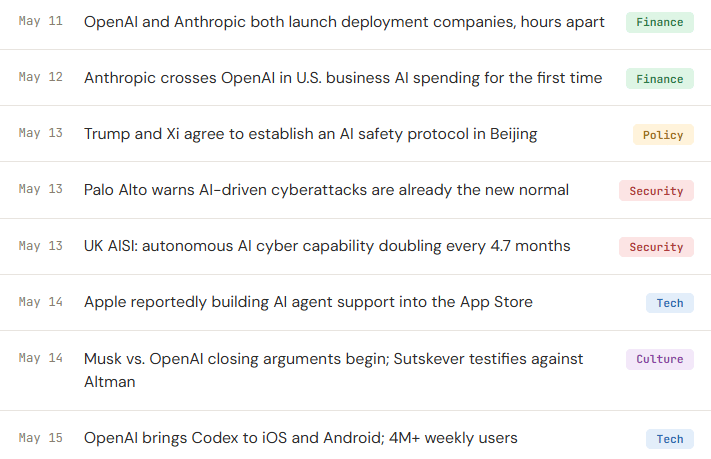
A year ago, Anthropic had 8% of U.S. business AI spending.
OpenAI had 32.
Ramp’s May 2026 AI Index tracks real corporate card spend across thousands of companies. This week it showed Anthropic at 34.4% business adoption, crossing OpenAI (now at 32.3%) for the first time.
Same week: the U.S. and China agreed to build an AI safety protocol. Apple started laying groundwork for AI agents in the App Store. And the UK quietly published data showing autonomous AI cyber capability doubles every 4.7 months.
The model race has a new winner every few weeks. The race to install, govern, and secure it just became the main event.
This week at a the Glance
Special Coverage
Anthropic Crossed OpenAI
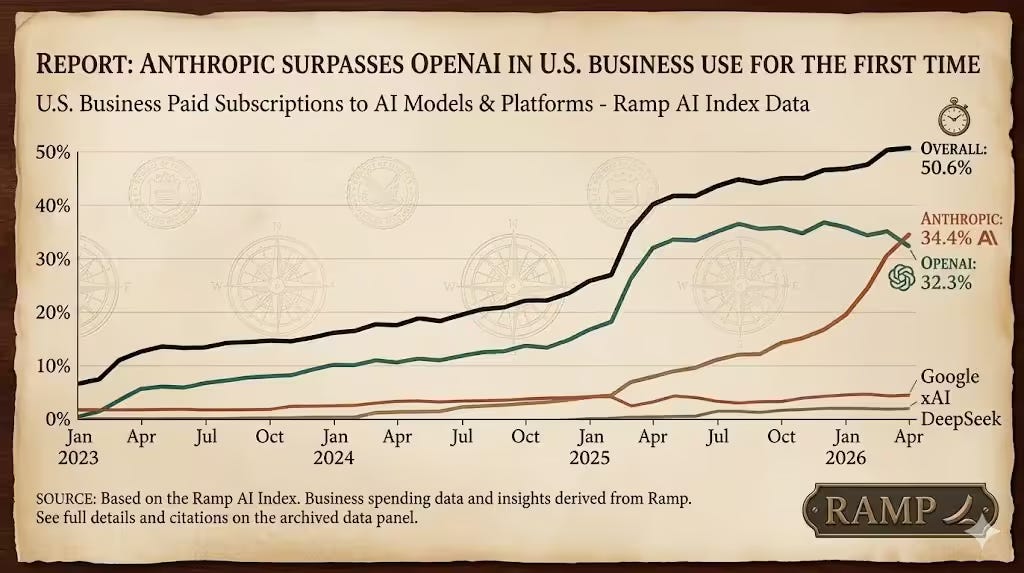
In May 2025, Anthropic had 8% of U.S. business AI adoption. OpenAI had 32.
By March 2026, Anthropic was capturing 73% of first-time AI business buyers.
This week, Ramp confirmed the crossover: Anthropic at 34.4%, OpenAI at 32.3%. Purchase data. Real companies.
The engine: Claude Code, which hit $2.5 billion annualized revenue by February alone.
As of April, Anthropic crossed $30 billion in annualized revenue. OpenAI sits at roughly $24 billion.
Enterprise contracts don’t behave like consumer apps. They renew annually, expand over time, and get embedded into company infrastructure. Switching one requires a procurement cycle. Not just deleting an app.
OpenAI read the room. Last week they launched a $4 billion deployment company with 19 partners, specifically built to fight back. Their chief revenue officer told employees: “the market is as competitive as I have ever seen it.” Read More
U.S. and China Made an AI Safety Deal
At this week’s Beijing summit, Treasury Secretary Scott Bessent announced a plan to establish an AI safety protocol.
The focus: “best practices” for frontier models. Specifically, keeping powerful AI out of the hands of nonstate actors — criminal networks, extremist groups, actors outside government control.
Nvidia CEO Jensen Huang joined the delegation as H200 chip sales to major Chinese firms remain in limbo.
A safety protocol won’t solve Taiwan or rare earths. But it creates one narrow lane where both governments agree that capability surprises need a shared floor.
That lane matters more than it sounds when the UK just published data showing AI cyber capability doubles every 4.7 months, with the latest frontier models outpacing even that. Read More
Lead Analysis
Apple Wants Agents in the App Store
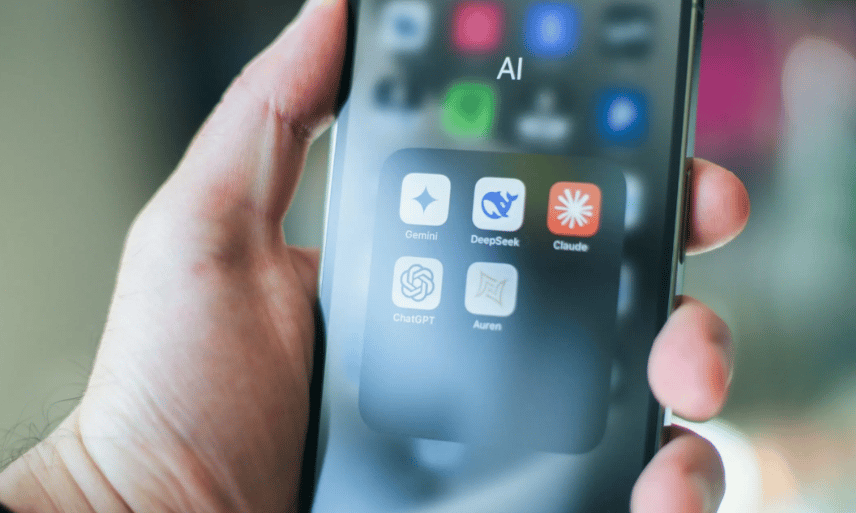
Apple is reportedly building AI agent support directly into the App Store, with a WWDC announcement expected June 8.
If it ships, agents could be found, downloaded, and run from your iPhone the same way apps are today.
OpenAI moved the same week. Codex is now on iOS and Android for the 4 million+ people who use it weekly. Review threads, code diffs, terminal output, and approve agent actions from your phone.
Google DeepMind introduced AI Pointer in Chrome: a context-aware cursor that understands what’s on your screen and can act on it.
Three companies, same destination, different angles. The question isn’t whether the interface layer shifts. It’s whose version your phone defaults to. Read More
AI Attacks Are Now the Baseline
Palo Alto Networks told investors this week that AI-driven cyberattacks have become the new normal.
They cited models including Anthropic’s Mythos and OpenAI’s GPT-5.5-Cyber as raising the stakes for every security team.
Google separately confirmed it stopped a recent attempt to use AI for a mass exploitation event.
The UK’s AI Safety Institute published research showing autonomous AI cyber capability has been doubling every 4.7 months, with the most recent frontier models outpacing even that curve.
That’s not a projection. It’s a measurement.
Most security budgets were written in 2025. Read More
Quick Hits
The OpenAI-Apple Deal Is Fraying The ChatGPT-Siri integration is reportedly souring. No confirmed details on what changed yet, but worth tracking alongside Apple’s WWDC agent plans.
Baidu Wants DAA to Replace DAU Baidu’s CEO proposed “Daily Active Agents” as the defining metric of the AI era. He estimated global DAA could eventually pass 10 billion. Worth watching whether this framing sticks the way MAU did. Read more
Google Turns Fitbit Into an AI Subscription Google Health Coach launches May 19 at $9.99/month, running on Gemini and pulling from Fitbit sleep, fitness, nutrition, and cycle data. A recurring revenue model built on hardware already in millions of homes. [Google Blog →]
OpenAI’s Co-Founder Testified Against Its CEO Closing arguments in Elon Musk‘s suit against OpenAI began May 14. Earlier, Ilya Sutskever testified he spent roughly a year gathering evidence of what he called Sam Altman‘s “consistent pattern of lying.” Former CTO Mira Murati testified Altman manages through deliberate chaos. These are allegations in active litigation, not findings. The Guardian →
Brain Feed

Everyday AI
Paste any AI response back and ask: “What would you change in this?” The model finds things you won’t. Takes ten seconds.
Before your go
The UK’s 4.7-month doubling figure for AI cyber capability was published without a press conference or a hearing. It deserved more noise than it got.
The same week, the U.S. and China agreed to coordinate on keeping AI away from the people most likely to misuse it. Both things are true at once, which is probably the most honest way to describe where we are.